Been busy the last couple of weeks with school starting up again. I really see more of that in my immediate future.
That said, I finally got the book sorted and it's live! Check that out here!
A lot of family and friends have already bought it, and I'm incredibly grateful for that. I just suck at advertising. Head over and read the first few chapters for free and post below. Better yet, if you have bought it and read it, write up a review on Amazon. I would really appreciate any feedback or word of mouth.
Like I said above, advertising is such an uphill battle. I tried trolling random forums to stick up a friendly blurb, but in the end, it just feels sluggish and amateurish. My biggest problem is confidence in myself. I like the book and all, it just feels weird trying to cram it down peoples' throats or work it into the right angle. Most of all, I don't believe in paying money for ads. In the end, I'll probably only cover what it cost to set those things up, if even. Maybe, I'll try it out for the next book as I think I'll have a much broader reader base for that one. Still, fantasy is not that hard to break in to and enjoy writing. I just hope others are liking their books.
What I'm trying to say is: I want to hear from you! Improvements, suggestions, or even just rants are fine. I am overwhelmed by the support I've been given with my first title. Maybe, I'll have a contest or something down the line.
Monday, September 3, 2012

Thursday, August 16, 2012
End War: Mistaidra Comes Out Tomorrow

Finally finished with editing!
I had meant to delay a little longer, but this already took most of the summer between a wedding, several short trips, and general business. I finally had enough and just threw the book on the queue at Amazon before I could over think it and back out. Yes, it has been edited (a couple of times through others, too), so rest assured. I was mostly worried that I would get too nervous again. Even still, I had nightmares this morning of getting only a measly two-stars and numerous rants and demands for refunds.
Personal terrors aside, my general impression of the Amazon Kindle Publishing has been pretty good. For those of you seeking to self-publish through Amazon in ebook format, I would highly recommend it. They offer a 30% or 70% royalty option. The details of each are easy enough to follow, and you still retain all the rights to your book if you should seek another publisher later. The most they ask is you give them the lowest price so they can remain competitive. There are horror stories out there. In particular, "Friday Night Lights" by H.G. Bissinger was published through Amazon and the iTunes store. When he promoted the book with free copies through Starbucks, Amazon mistook the promo for a price drop and changed the price to match the freebie even though he was still receiving royalties for the promotional through Apple. It was a mistake, and Bissinger still publishes his ebook through both companies. Royalties are tricky business, but ultimately, publishing ebooks is much more rewarding, putting you at command.
In the end, I chose the 70% option, but that precluded a minimum price tag of $2.99, "moderately priced" for a digital book. Now, 70% of 2.99 is $2.09. That's not a bad deal. Better, my book came in at about 250 kb after formatting and adding a custom cover. If yours is a hefty mb or more, there is a $0.15 delivery fee. Mostly, this is to cover server costs for downloading your book and how much data it's taking up. That's really a fair deal. There is also tax withholding if you live in the states. The final cut for my commission came in at just barely $2. Had I published through a traditional venue, I would be lucky to get $1-$2 per book sold. Even still, there are promotions, hardback copies that don't sell as much, and a much more limited audience as more patrons flock to the electronic storefront. I'm not completely shut down to physical copies, and many authors who have made it online usually go through traditional means for the physical copy. "50 Shades of Gray" was nothing more than a fanfic (story written by a fan of another author's work) before hitting it big.
The business end of the deal is actually not that bad when you consider how many companies have hidden agendas entitling them to your work. Most online message boards even have an addendum that they ultimately own your work when it comes to promotions. So, reassured that my work would remain my own, I set about formatting.
This is another process that was surprisingly easy and friendly. I even made a few faux pas but was able to correct them. Within a couple hours, I had finished reformatting, and that was with my toddler hanging on my arm. The biggest mistake I made was indenting my paragraphs. I come from the old school where you had to space or tab your first sentence. These days, you can set Microsoft Word to do it for you. Amazon's e-reader doesn't recognize the tab spacing, and your whole work can become one giant paragraph in no time flat. A quick Google to find the solution rather than go through each line, and I was using the Find and Replace key like a pro. From there, it was just aesthetic changes. A quick note: remove colored text and fancy fonts. The Kindle doesn't display these even with the full-color Kindle Fire. It's part of their formatting so that the text can be read across multiple devices. If the script or color is that important to the story, consider inserting them as pictures. Read the site's instructions on how to do this so they don't get dropped.
With the book in the queue, I hit the "Save and Publish" button, but that popped up a gray text "in review." What is this nonsense? Well, lately, Kindle has been checking over the formatting, text, and rights. This is a good thing, ultimately. If someone else mysteriously got hold of my work and sent it through them, I would want to know about it, and if I had stolen another's published work, the same. A few years back, the company came under fire for publishing an instruction book for pedophiles, so all the more attention to detail is expected. On the consumer's end, this process ensures the book will be read by all devices. Unfortunately, this means a 12 hour queue. Yep, 12 hours, and that's if you don't make my silly mistake. This morning, I woke up ready to attack the bookshelf and see my book in the Amazon shelves. Nothing returned my search for "Mistaidra", so I stumbled into my queue to look. "Draft" status was written in gray beside my title. Huh? Clicking the name only turned up that I hadn't saved this and given it the okay for publishing. Because it was morning, and I am an idiot in the morning, my rationale told me to go back into the work and click "Save and Publish" again. Turns out, you have to click the check box next to the title on your shelf. Clicking as I did sent it back to the 12 hour queue. x.x;
So, "Mistaidra" is out tomorrow! :D
I'll still hit my weekend deadline, but I can't help feeling like I rushed a bit on that detail. Yes, $2.99 is more than the impulse-friendly $0.99 that we're seeing more of, but I don't think people would have to scrape the barrel for this one. Paperbacks are usually a minimum of $7 with a lot of accomplished authors shaking their cups to the tune of $8.99 and more for ebooks. If you do get the book, please review and star it. I would greatly appreciate it. Thanks again!
Sunday, August 12, 2012
Fantasy Cliches #1: Gold

Biggus Dickus emblazons the Aureii.
Here's the segment where I poke a little fun at myself and the rest of the fantasy writing community by exposing some cliches. This week's offering is Gold.
We know it and love it. It sparks wars and conquest, wins the hearts of countless princesses, and inspires villainy. When an author wants to instill awe, the usual resort is gold. Hem dresses with it, drape it across a nubile slave girl, and stack it in mountains through a dragon's hoard. You can't go wrong with gold, right?
Cliches are usually in place for a reason. We like money and valuable things like rare metals. Silver and gold were our natural currency for thousands of years and even straight up until the 1930's. When we want to show the stakes are high and the rewards great, a sizable treasure is visibly appealing and recognizable. I'm not saying I wouldn't mind raiding a demon's loot for the yellow shinies, and that's why we are easily seduced by this cliche.
Gold is valuable. Gold is rare, but we seem to forget that latter part when it comes time to pay the tab. That's why gold is a cliche this week.
Currency is one of the biggest, most complicated ideas we can embrace through our natural hunter gatherer origins. When did we decide bits of inedible metal were more sought after than a deer or some grain? I won't even go into Executive Order 6102 that changed us over to bits of paper and even cheaper metal. It is what it is, though, and the aesthetic appeal of the metal is without doubt.
However, currency, like all human-wrought inventions, has rules and standards. Literally, the gold standard. We seem to forget that when we read a sweeping tale of treasure hunting pirates who don't seemed phased at paying their ale bills with Florins. Today, an ounce of gold bounces around $1600, and even older coins are valued for their much higher gold content.
That doesn't mean no one can have gold. If anything, your fantasy world may be rich in the mineral as a key point of interest for invaders. You just have to write your rules down and stick to them. If gold is in abundance, what is truly valuable to the locals? How do you value an exchange across the border?

A Koban isn't nearly as tasty as rice.
The Japanese had a clever solution in their gold Koban coin. Rice is the most valuable grain in all of Japan. It is still a staple in the every day meal and was the fine line between starvation and flourishing for centuries. Rice was so valuable, many farmers paid their taxes in shares of their crops for that year. When the Portuguese arrived, they preferred gold. The Koban offered a good bridge. The coin was the equivalent of one year's worth of grain for one person. In exchange for the Koban coins, the government would distribute the rice from their coffers or vice versa. Of course, as time wore on, cheaper metals were added to the gold, and the older, purer coins became more valuable than a mere one year's grain.
In England, a small chest was unearthed containing 43 aureii or Roman gold coins. At the height of Roman conquest with gold pouring in from every corner of the known world, this was four years worth of a Roman soldier's salary, and he hoarded this treasure in a faraway land with no taverns to spend it on. Imagine a soldier today returning from his tour and remembering he hadn't had to spend money on food, lodging or clothing for the last four years. Unless he sent it back to family to spend, he would have a pretty tidy stock to live off of.
You can use gold and silver in fantasy writing. You just have to figure out the conversions and the practicality. One of my biggest pet peeves is reading a book and seeing the main character spend money thoughtlessly. Particularly, when a character spends 75 silver pieces for a sword made of cheap steel, and then, he turns around and buys a silver mirror for 25. First, at what point do the conversions matter enough that carrying 100 heavy metal coins around is better than one expensive coin and a couple smaller? 100 quarters would tear my purse apart for $25 worth of currency total. Better yet, why aren't there banking systems and writs? That sort of system was very well established in the Roman times. The other point is the metal, again. Wouldn't melting the mirror down produce more silver than what you spent? The base reason why gold is still valuable in any form is you can melt it down and reshape it easily. Silver is the same. A coin from Spain or England didn't matter as long as the purity and weight were roughly equal to your price.
If you're going to use gold, establish what it's worth. Otherwise, you're going to have a detached world where a gold coin will buy an apple or an orchard without any logic to it.
Wednesday, August 8, 2012
Fantasy to Film
Let me explain.
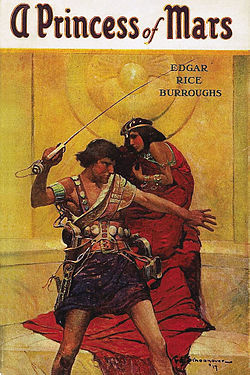
In 1917, Tarzan creator, Edgar Rice Burroughs, wrote a wild adventure taking place on the surface of the red planet. He titled his creation, "A Princess of Mars," and 11 books detailed the adventures of John Carter, a Virginian Earth man who fought the battles of a world beyond the scope of our own. Burroughs's imagination wrought the foundations of the science fiction genre, and Carter's high-bounding action became the forerunner of Superman and other comic heroes.
Unfortunately, that seemed to be the breadth of what Disney picked up on as the movie became a mindless parade of aliens and bad actors with a gratuitous background story that did little to aid the development of the characters. I'm usually a big fan of Disney and write many blank checks for them when it comes to story. More, I like when screenwriters take from a book and change things around. Most of the time, the changes are instances that drive the plot better like "The Watchmen" or address oversights of the originals. With that in mind, John Carter was a unique disappointment.
I won't say it was entirely irredeemable. If anything, I didn't find myself bored at all, but the actors were particularly bad. Specifically, the princess herself seemed little more than a model slapped on the screen to sell a little sex. It's a shame, too. We get a glimpse of her work as a scientist, but she might as well be delivering her lines to her prompter just off camera. I kept craning my neck in the dark theater just to see what she thought was so interesting off screen, though I suppose the blame for that falls on the cinematographer. John Carter himself was dull. We've fallen into this era of the antihero where everyone needs a "my family died" back story and a bad attitude. Sure enough, he gets the same emo treatment. I guess you could argue that his loss of a family brings him closer to Tar Tarkas, the green-man chieftain, but the delivery was so poor, I found myself annoyed with the flashbacks and guessing that subplot by the end of the first gray-tinted flash of a woman.
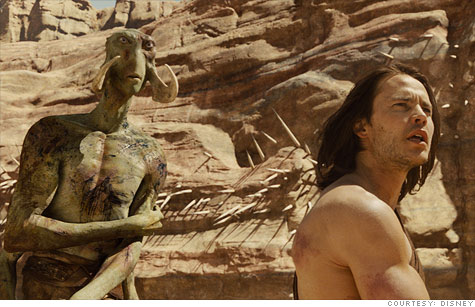
We haven't mastered shirt technology on this planet.
And that's the most blame I could put on the movie, really. Surprisingly, the CG wasn't half bad. I liked the design of the green men and Woola, a sort of fleshy bulldog creature that can dart about, and the action was engaging. My husband summarized the movie perfectly: It's not bad. It's not good, but I didn't want to bang down the little window of the ticket office for my money back. I can see why Disney is projecting a $200 million loss on the project, but I think a good deal of better advertising and tightening the script might save a sequel. In the end, I was left with a mixed feeling of wasted potential. The movie failed, but I wanted to read the book.
So I found "A Princess of Mars" on Amazon and downloaded it to the Kindle right away. It sat there for a while, but as my schedule cleared up, I started in on the Martian adventure.
What a difference.
Every once in a while, I read a book that I know would sound strange outside its own cover. A boy who lives in a cupboard goes on to a wizarding academy in modern Britain would be a good example. I could tell you this is a high-flying adventure of an Earth warrior on Mars, but I don't think that alone would do the scope of the novel justice. Burroughs imagined the scale of a planet we could only guess at through hazy lenses and brought an Earthling there to romp about.
Fleeing a pack of brigands, the main character finds himself in a cave that somehow connects to the red world beyond. Because of his more dense Earthling muscle structure, Carter is able to leap to astonishing heights and topple threats with a single blow. With his astonishing abilities, he finds a place among the green men of Mars, tusked savages who have adapted to their dying planet with ruthlessness. There, he learns the language and settles into a life among the natives with Sola, a kind-hearted caretaker, and Woola, his only equivalent to the familiar Earth dogs he misses. When a red Martian ship appears on the horizon and a beautiful princess is taken captive, John Carter starts his epic journey across the planet to return Dejah Thoris to her homeland.
Short, sweet and simple, the story of John Carter's first journey to Mars is hardly the breathtaking epic of the Dune series or near the scale of modern storytelling. It was one of the first pulp science fiction novels out there. If anything, you could accuse the screenwriters of trying to give more depth to the characters and settings, but that led to overdoing the drama over the pure fantasy the book was meant to bring its readers. I feel the book was always meant to be simple; an enthralling escape to a world where nothing is supposed to make sense anymore. In that regard, it is a fantastic success and inspired millions all over the world for being as approachable as it is.
That isn't to say there is no depth to the story. Burroughs's imaginings of a world without water were clever and beyond his time. Mechanics of air pumps, psychic controls, and even architecture rang out through the tale. Some of his gizmos have even translated through time to many of our own modern toys. His imagination is hardly taking a vacation, and he approaches each concept with as much thought as he can muster.
Carter himself is an unfortunate Mary Sue. He is, of course, the fastest, strongest, smartest, most empathetic, and special little Earthling to ever gain the chieftainship of the Tharks, but those traits are emphasized to drive home the culture of the green men, and more, you can't really write off chivalrous as a fault in turn of the century America. He recognizes and appreciates the sympathies of Tars Tarkas and Sola, and his typical "because love" motivation at least serves to move the story along. I won't give away too much, but even the brutish Tharks evolve as the story progresses. My only real protest is that Carter himself doesn't, really. He just goes on being a Virginian on Mars, but that's enough for the first book.
Overall, I say give this story a try. It's free on Amazon and a great jumping point (punny) for adventure escapism. Best of all, it's a quick read with a commanding use of language and inflection that are Burroughs's hallmarks.
Tuesday, August 7, 2012
Coming Soon
Hello, and welcome to my first blog on writing and publishing.
I've been an avid reader all my life, and on occasion, I would even write from time to time. My first "novel" was finished when I was in my teens, a fantasy much in the same vein as one of my favorite authors but considerably lacking in direction. Unfortunately, these early endeavors were never taken seriously, even by myself, and I feared the arduous task of finding a publisher even when I grew serious. For a while, I abandoned writing fantasy and took to forum posts and role playing games. I still wrote, but it lost the same verve. Deep in a rut of depression and out of passion, I pulled myself back to the keys and started to write again. Lo and behold, I enjoyed it still. My modest goal of finishing a fantasy story over the summer was completed in under a month, and now, I'm starting to humor the old notion of sending my books out there for people to read.
But what now? There's still editing, and do I fall into the trouble of trilogies and senseless sagas that plague the genre? In this new era of easy self-publishing and indie writer stars, even my little corner of the internet seems laughably small and inadequate. But there is room for growth in the digital world, and new voices abound. What little knowledge I have, I am always happy to share if people would like to hear it.
Admittedly, I am no great mind when it comes to promoting myself and stirring up communities, but I am eager to teach and learn in turn. Here, we can discuss the elements of writing effective characters and fine-tuning ideas to make them print worthy. This blog will be a sort of haven for the instructor in me, and I hope you find it just as entertaining and informative as I feel writing it as I publish my first novel.
What's in store: writing tips, book reviews, self-publishing insights, and more!
I've been an avid reader all my life, and on occasion, I would even write from time to time. My first "novel" was finished when I was in my teens, a fantasy much in the same vein as one of my favorite authors but considerably lacking in direction. Unfortunately, these early endeavors were never taken seriously, even by myself, and I feared the arduous task of finding a publisher even when I grew serious. For a while, I abandoned writing fantasy and took to forum posts and role playing games. I still wrote, but it lost the same verve. Deep in a rut of depression and out of passion, I pulled myself back to the keys and started to write again. Lo and behold, I enjoyed it still. My modest goal of finishing a fantasy story over the summer was completed in under a month, and now, I'm starting to humor the old notion of sending my books out there for people to read.
But what now? There's still editing, and do I fall into the trouble of trilogies and senseless sagas that plague the genre? In this new era of easy self-publishing and indie writer stars, even my little corner of the internet seems laughably small and inadequate. But there is room for growth in the digital world, and new voices abound. What little knowledge I have, I am always happy to share if people would like to hear it.
Admittedly, I am no great mind when it comes to promoting myself and stirring up communities, but I am eager to teach and learn in turn. Here, we can discuss the elements of writing effective characters and fine-tuning ideas to make them print worthy. This blog will be a sort of haven for the instructor in me, and I hope you find it just as entertaining and informative as I feel writing it as I publish my first novel.
What's in store: writing tips, book reviews, self-publishing insights, and more!
Subscribe to:
Posts (Atom)