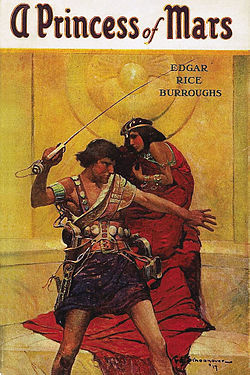
Let me explain.
In 1917, Tarzan creator, Edgar Rice Burroughs, wrote a wild adventure taking place on the surface of the red planet. He titled his creation, "A Princess of Mars," and 11 books detailed the adventures of John Carter, a Virginian Earth man who fought the battles of a world beyond the scope of our own. Burroughs's imagination wrought the foundations of the science fiction genre, and Carter's high-bounding action became the forerunner of Superman and other comic heroes.
Unfortunately, that seemed to be the breadth of what Disney picked up on as the movie became a mindless parade of aliens and bad actors with a gratuitous background story that did little to aid the development of the characters. I'm usually a big fan of Disney and write many blank checks for them when it comes to story. More, I like when screenwriters take from a book and change things around. Most of the time, the changes are instances that drive the plot better like "The Watchmen" or address oversights of the originals. With that in mind, John Carter was a unique disappointment.
I won't say it was entirely irredeemable. If anything, I didn't find myself bored at all, but the actors were particularly bad. Specifically, the princess herself seemed little more than a model slapped on the screen to sell a little sex. It's a shame, too. We get a glimpse of her work as a scientist, but she might as well be delivering her lines to her prompter just off camera. I kept craning my neck in the dark theater just to see what she thought was so interesting off screen, though I suppose the blame for that falls on the cinematographer. John Carter himself was dull. We've fallen into this era of the antihero where everyone needs a "my family died" back story and a bad attitude. Sure enough, he gets the same emo treatment. I guess you could argue that his loss of a family brings him closer to Tar Tarkas, the green-man chieftain, but the delivery was so poor, I found myself annoyed with the flashbacks and guessing that subplot by the end of the first gray-tinted flash of a woman.
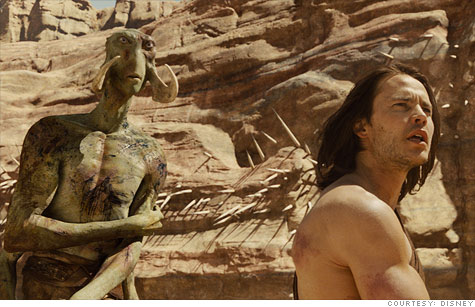
We haven't mastered shirt technology on this planet.
And that's the most blame I could put on the movie, really. Surprisingly, the CG wasn't half bad. I liked the design of the green men and Woola, a sort of fleshy bulldog creature that can dart about, and the action was engaging. My husband summarized the movie perfectly: It's not bad. It's not good, but I didn't want to bang down the little window of the ticket office for my money back. I can see why Disney is projecting a $200 million loss on the project, but I think a good deal of better advertising and tightening the script might save a sequel. In the end, I was left with a mixed feeling of wasted potential. The movie failed, but I wanted to read the book.
So I found "A Princess of Mars" on Amazon and downloaded it to the Kindle right away. It sat there for a while, but as my schedule cleared up, I started in on the Martian adventure.
What a difference.
Every once in a while, I read a book that I know would sound strange outside its own cover. A boy who lives in a cupboard goes on to a wizarding academy in modern Britain would be a good example. I could tell you this is a high-flying adventure of an Earth warrior on Mars, but I don't think that alone would do the scope of the novel justice. Burroughs imagined the scale of a planet we could only guess at through hazy lenses and brought an Earthling there to romp about.
Fleeing a pack of brigands, the main character finds himself in a cave that somehow connects to the red world beyond. Because of his more dense Earthling muscle structure, Carter is able to leap to astonishing heights and topple threats with a single blow. With his astonishing abilities, he finds a place among the green men of Mars, tusked savages who have adapted to their dying planet with ruthlessness. There, he learns the language and settles into a life among the natives with Sola, a kind-hearted caretaker, and Woola, his only equivalent to the familiar Earth dogs he misses. When a red Martian ship appears on the horizon and a beautiful princess is taken captive, John Carter starts his epic journey across the planet to return Dejah Thoris to her homeland.
Short, sweet and simple, the story of John Carter's first journey to Mars is hardly the breathtaking epic of the Dune series or near the scale of modern storytelling. It was one of the first pulp science fiction novels out there. If anything, you could accuse the screenwriters of trying to give more depth to the characters and settings, but that led to overdoing the drama over the pure fantasy the book was meant to bring its readers. I feel the book was always meant to be simple; an enthralling escape to a world where nothing is supposed to make sense anymore. In that regard, it is a fantastic success and inspired millions all over the world for being as approachable as it is.
That isn't to say there is no depth to the story. Burroughs's imaginings of a world without water were clever and beyond his time. Mechanics of air pumps, psychic controls, and even architecture rang out through the tale. Some of his gizmos have even translated through time to many of our own modern toys. His imagination is hardly taking a vacation, and he approaches each concept with as much thought as he can muster.
Carter himself is an unfortunate Mary Sue. He is, of course, the fastest, strongest, smartest, most empathetic, and special little Earthling to ever gain the chieftainship of the Tharks, but those traits are emphasized to drive home the culture of the green men, and more, you can't really write off chivalrous as a fault in turn of the century America. He recognizes and appreciates the sympathies of Tars Tarkas and Sola, and his typical "because love" motivation at least serves to move the story along. I won't give away too much, but even the brutish Tharks evolve as the story progresses. My only real protest is that Carter himself doesn't, really. He just goes on being a Virginian on Mars, but that's enough for the first book.
Overall, I say give this story a try. It's free on Amazon and a great jumping point (punny) for adventure escapism. Best of all, it's a quick read with a commanding use of language and inflection that are Burroughs's hallmarks.

No comments:
Post a Comment